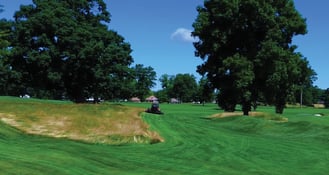
Native areas have become more than an aesthetic enhancement on modern golf courses. They represent a strategic opportunity to improve ecological function, reduce maintenance inputs, and create visual contrast that defines the character of a property. As outlined in the Quali-Pro Native Areas Program, well-managed native spaces enhance wildlife habitat, stabilize slopes, conserve water, and reduce overall resource demands, without the need to create new areas.

Native does not mean neglected. Without a structured approach to weed and insect control, native stands can quickly transition from intentional design features to areas overrun by invasive annual grasses, broadleaf weeds, sedges, and damaging insects.
That is why we developed The Quali-Pro Cool-Season Native Areas Program, to provide superintendents with a clear, seasonal framework for protecting what’s already working on their course.
Why Native Areas Require a Different Mindset
Native areas are intentionally low-input, but not necessarily low-management. Fine fescues and regionally adapted grasses can thrive with less fertility, irrigation, and mowing, yet those same characteristics reduce their ability to outcompete invasive weeds once they establish.
Because mowing is infrequent and fertility is limited, weed control must be proactive rather than reactive. Strong preemergent timing becomes foundational, postemergent applications must be selective, while growth regulation can improve density and uniformity. Insect control must also provide long residual protection to limit number of applications while still providing acceptable levels of control.
A programmatic approach prevents reactive spraying and instead builds season-long control into the area. Native areas succeed when they are managed with structure and intention, not left to chance.
The Foundation: Preemergent Weed Control with Prodoxaben
The foundation of the Quali-Pro Native Areas Program is Prodoxaben SC and G (Prodiamine + Isoxaben). This dual-active combination creates a durable preemergent barrier against both annual grasses and broadleaf weeds.
Independent research trials show:
Long-residual preemergent control is essential to prevent early-season weed pressure from disrupting uniformity. Prodoxaben is positioned as a fall application, applied prior to the emergence of target weeds to establish a strong soil barrier heading into the following spring. This early foundation reduces spring breakthroughs and protects native area stands during their most vulnerable transition period. For areas where liquid applications are less practical, the granular formulation offers flexibility while maintaining the same dual-mode-of-action strategy.
A follow-up spring application of QP Dithiopyr 2EW then complements this approach, reinforcing and extending preemergent control of annual grasses and broadleaf weeds. Together, this sequential strategy builds layered residual protection, minimizing in-season rescue treatments and preserving the integrity of the native stand.

Strategic Postemergent Cleanup
Even the strongest preemergent program requires some targeted in-season support.
The Quali-Pro Native Areas Program incorporates:
The program calendar (Spring, In-Season, Fall) emphasizes timing over volume. By spot treating problem areas rather than blanket spraying, superintendents preserve desirable native grasses while maintaining the visual integrity of the stand.
Broad-Spectrum Insect Protection with Minimal Disruption
Weed control stabilizes the stand, but insect feeding can quietly undermine it.
Native areas often harbor damaging white grub populations and various turf-feeding caterpillar species. For this reason, Contrado SC (Chlorantraniliprole) is incorporated as the insect control backbone of the program.
Applied in May, often tank-mixed with Pac-Low SC for operational efficiency, Contrado SC provides:
This is particularly important in native areas, where habitat preservation is a priority. Long residual activity allows for a single, early-season application rather than repeated disturbances later in the summer.

Growth Regulation to Enhance Structure
The goal of native areas on most golf courses is often a wispy, yet uniform stand that provides definition, playability, and aesthetic contrast without becoming overly thick or penal.
Pac-Low SC (Paclobutrazol) supports that goal by promoting turgidity and tiller production, while limiting excessive vertical elongation. Growth regulation helps enhance structure, improve uniformity, and maintain the intended playability and aesthetic of the stand. Importantly, when properly timed, applications still allow for natural seedhead formation of grasses, preserving the visual character and texture that define well-managed native areas.

Strategic Mowing to Support Weed Control
Native stands should be mowed in the spring at least once, and up to twice, through mid-May to remove old, matted growth and encourage uniform spring green-up. This early-season mowing stimulates healthy new growth, allowing desirable grasses to compete more effectively with emerging weeds.
Just as importantly, mowing prior to herbicide applications improves product performance. Removing residual biomass allows preemergent herbicides to reach the soil surface more uniformly and ensures better contact with small, actively growing weeds during postemergent applications.
After these early-season mowings and herbicide applications, native areas should be allowed to grow throughout the summer to establish density, structure, and visual impact. A fall conditioning mow can also be performed if desired, particularly prior to fall herbicide applications; however, superintendents should recognize that fall mowing removes standing material that provide winter interest and habitat for overwintering wildlife.
The Power of a Program, Not Just Products
Native areas represent one of the most visible commitments a golf course can make toward environmental stewardship and operational efficiency. But without protection, they can quickly lose structure, uniformity, and performance.
Rather than reacting to weed breakthroughs or insect damage, superintendents can now manage native areas proactively, protecting ecological value while maintaining course aesthetics. This is not about adding more applications. It is about applying the right tools, at the right time, in a structured program that preserves the beauty and utility of what’s already native.
For a full overview of the Quali-Pro Cool-Season Native Areas Program and seasonal timing guidance, review the program guide or contact your Quali-Pro representative.

With contributions from Shannon Slevin, Quali-Pro Northeast Manager