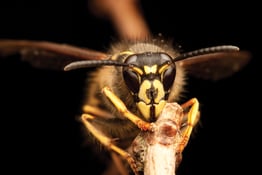
I recently heard the term “spicy jalapenos” used to describe stinging insects, primarily those that dogs try to catch and eat and immediately regret. But are all stinging insects Spicy Jalapenos? Much like the spiciness can vary significantly by pepper, so can the sting of an insect. Infact both the spiciness of a pepper and the sting of an insect have been studied and ranked. Peppers go by the Scoville scale. In the early 1900s, pharmacologist Wilbur Scoville diluted various peppers in sugar water until the very brave taste testers could no longer detect the capsaicin (the heat). The result was all the peppers ranked in order of Scoville Heat Units (SHU). In the late 1900s, entomologist Justin Schmidt categorized stinging hymenopteran insects (ants/bees/wasps) into 4 tiers based on the level of pain he felt when stung. Let’s see where some of our more common stinging insects in North America line up with our tastier counterparts, the peppers. Perhaps our dogs have been trying to eat much spicier than a Spicy Jalapeno!
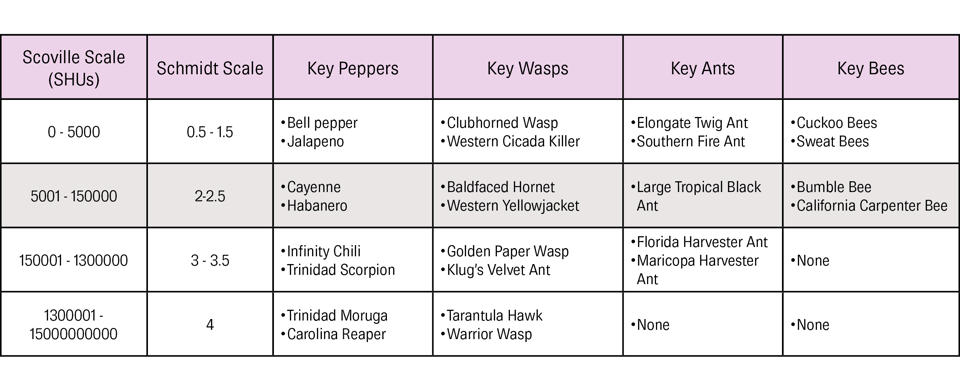
Though bees and ants are certainly guilty of being spicy jalepenos (even spicy habaneros!), it’s wasps that dominate the spicier side of the scale.
Tarantula Hawks: Despite it’s scary name, huge size (2 inches long), and painful sting, Tarantula Hawks are docile creatures that feed on flowers. But the females also hunt tarantulas and need that stinging power to knock them out and paralyze them. Fortunately it’s rare for people to be stung by these spicy Carolina Reapers.
Velvet Ants: Ants are, as a group, not as spicy as wasps. So it makes sense that the wingless female wasps would try to pretend to be a more benign ant to predators. That’s what velvet ants are – wasps that look like ants. While the males are content to feed on nectar, the females feed on larvae and pupae of ground-nesting wasps and bees (some species will even attack flies and beetles).
Paper wasps: There are many species of paper wasps with varying levels of spiciness. They all are hairless (unlike bees) and (like ants) have a “waist”: a narrow petiole between their thorax and abdomen. Paper wasps get their name from the nests they make, cells and walls made from a fibrous paste of saliva and chewed wood.
Baldfaced Hornets: Here is another inaccurately named pest… these Spicy Cayennes are actually yellowjackets, not hornets. The characteristic football-shaped papery nest of the baldfaced hornet is actually characteristic of all yellowjackets in the same genus. Unlike many other yellowjackets, baldfaced hornets have white markings on the face, as do the legs, thorax, and abdomen. If you’re dealing with Baldfaced Hornets, wear eye protection, they will often “spit” venom from their stinger into the eyes of their predators.
Cicada Killers: That brings us to one the mildest peppers of the group, a true Spicy Jalapeno, the cicada killers. Like the Tarantula Hawks, these are large wasps that can look intimidating. Though they can sting humans, they rarely do. Instead, the females sting cicadas and bury them in underground tunnels. They are not aggressive and control is typically unnecessary.
For those spicy peppers that require control, the best bet is to find the nest and treat with a dust or liquid insecticide, such as Stryker Wasp & Hornet Killer. Find the nest during the day, then put on a bee suit and treat the nest at night. For most nests (especially Baldfaced Hornets), you’ll have the most success if you directly inject the insecticide into the wasps – essentially sealing their exit hole with the tip of the applicator. For others, you may have success from a safer distance away. Stryker Wasp & Hornet Killer is an aerosol ready-to-use pyrethroid formulation that kills on contact from 20 feet away and appropriate to protect our pets from most of the spicy peppers that tempt us… just don’t add these spicy peppers to your salsa.